
The Cognitive Architecture of AI Mastery: How to Outpace Your Peers in Workflow Engineering

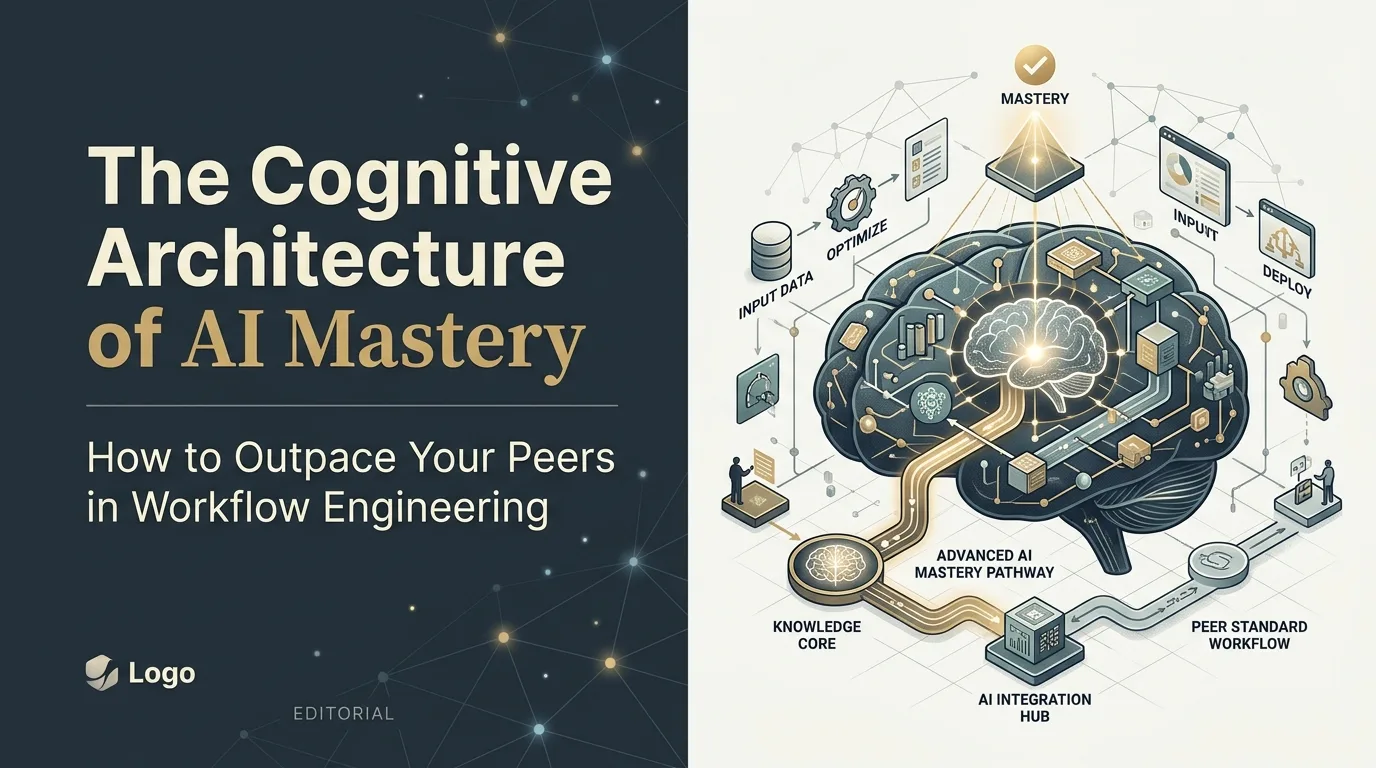
Most professionals are approaching artificial intelligence all wrong. They treat tools like ChatGPT, Claude, Midjourney, and custom LLM agents as isolated software applications—shiny digital toys to open, test for ten minutes, and close when they hit a wall. Meanwhile, the top 1% of operators aren't learning tools at all. They are building cognitive pipelines.
If you want to outpace your colleagues, stop trying to memorize every new wrapper, plugin, or feature drop released on Product Hunt. The half-life of a specific AI feature interface is roughly four months. The half-life of a robust workflow design framework is decades. Here is the exact blueprint for building a high-velocity AI learning system that turns you into the undisputed automation expert in your organization.
1. Stop Prompt Engineering: Start System ArchitectingThe phrase "prompt engineer" is already obsolete. Typing clever sentences into a text box is a low-leverage skill that will soon be commoditized entirely by native model improvements. To learn workflows faster than anyone else around you, you need to transition from an end-user mindset to a systems architect mindset.
An AI workflow is not a single prompt; it is a deterministic pipeline with probabilistic execution steps. When you look at a task—say, transforming raw qualitative user research into a prioritized product roadmap—do not ask, "What should I type to ChatGPT?" Instead, dissect the operation into atomic units:
- Ingestion: How does unstructured data enter the system? (PDFs, transcripts, API webhooks)
- Transformation: What sequential logic needs to be applied? (Extraction, categorization, sentiment scoring)
- Validation: How do you catch hallucinations or format errors before downstream consumption?
- Output: What structural schema is required for the final delivery? (JSON, markdown, Airtable row)
When you map tools like Make.com, Zapier Central, and programmatic API calls to these discrete units, you stop learning "how to use a tool" and start building "modular cognitive infrastructure." This shift allows you to port your workflows across entirely different foundational models in minutes.
2. The 80/20 Rule of Model-Agnostic Context WindowsYour colleagues are wasting hundreds of hours learning the idiosyncratic UI quirks of specific AI platforms. They are memorizing menu layouts, prompt caching limits, and proprietary sidebar features. This is a massive waste of cognitive bandwidth.
Master the underlying mechanics of context windows, temperature settings, system prompts, and Retrieval-Augmented Generation (RAG). Once you understand how these four pillars function under the hood, you can walk up to any new interface—whether it is an enterprise-grade LLM deployment or an open-source model running locally via LM Studio—and achieve expert-level results within ten minutes.
The Triad of Model MasteryFocus your learning engine exclusively on three foundational concepts that govern 90% of modern generative AI performance:
- State Management: How the model tracks history and maintains persona constraints across multi-turn interactions.
- Vectorization & Embedding Logic: Understanding how data is chunked, stored in vector databases, and retrieved during contextual queries.
- Deterministic Guardrails: Forcing probabilistic models to output predictable schemas using JSON mode, function calling, and system constraints.
You cannot learn advanced workflows by reading newsletters or watching YouTube tutorials. You learn by breaking things in a controlled environment. The professionals who dominate AI adoption have a dedicated personal workspace—a sandbox where they test, fail, and iterate away from the scrutiny of their day job.
Here is the exact framework I use to test any new AI workflow before deploying it to a team environment:
- Phase 1: Zero-Shot Isolation. Test the capability using a raw API call or a clean playground environment with zero UI distractions. Establish a baseline success rate.
- Phase 2: Error Injection. Deliberately feed the workflow messy, contradictory, or malformed data to see where it breaks. This teaches you the failure modes faster than any success case ever will.
- Phase 3: Automation Layering. Wrap the prompt logic in an orchestration tool (like Python scripts or low-code builders) to handle inputs and outputs automatically.
- Phase 4: Team Abstraction. Strip away the technical complexity and build a clean, bulletproof interface that non-technical colleagues can use with a single click.
When you see someone in your industry posting an incredible automated AI workflow, do not just applaud it. Reverse-engineer it immediately. This is the fastest shortcut to competence used by elite developers and product managers alike.
Ask yourself these diagnostic questions:
- What was the exact input payload that triggered this output?
- Did they use a single-shot completion or a multi-step agentic loop where the model critiques its own work?
- Where are the handoffs between human oversight and automated execution?
By treating every advanced implementation as a puzzle to be solved, you train your brain to spot patterns in workflow design. Soon, you will look at legacy business processes and instantly visualize the AI-augmented architecture required to run them ten times faster.
5. Cultivating the "Agentic Mindset"The biggest bottleneck for your peers is that they still think like manual workers who occasionally use software. They write a prompt, wait for an answer, copy-paste it into an email, and repeat. This is linear productivity.
To pull ahead, you must adopt an agentic mindset. Shift your focus from executing tasks to designing autonomous loops. Ask yourself: "How can I build a system where the AI not only does the work, but checks its own output, flags anomalies, and notifies me only when human intervention is strictly required?"
When you master multi-agent frameworks—where one LLM acts as a researcher, another as a writer, and a third as a rigorous editor—you stop competing with other humans. You start competing with entire departments.
Summary Action PlanIf you want to leave your colleagues in the dust starting this week, ditch the hype. Stop hoarding prompt lists and unsubscribe from superficial AI news outlets. Instead, pick one core business bottleneck, map its data pipeline, apply model-agnostic architectural principles, and build a self-correcting workflow. Master the system, not the software, and the tools will always bend to your will.
The Cognitive Architecture of AI Mastery: How to Outpace Your Peers in Workflow Engineering
Stop memorizing prompts. Learn the cognitive pipelines and workflow engineering frameworks top 1% operators use to master AI tools faster.