
How to Build a Personal AI Learning Curriculum for Free (2026 Edition)

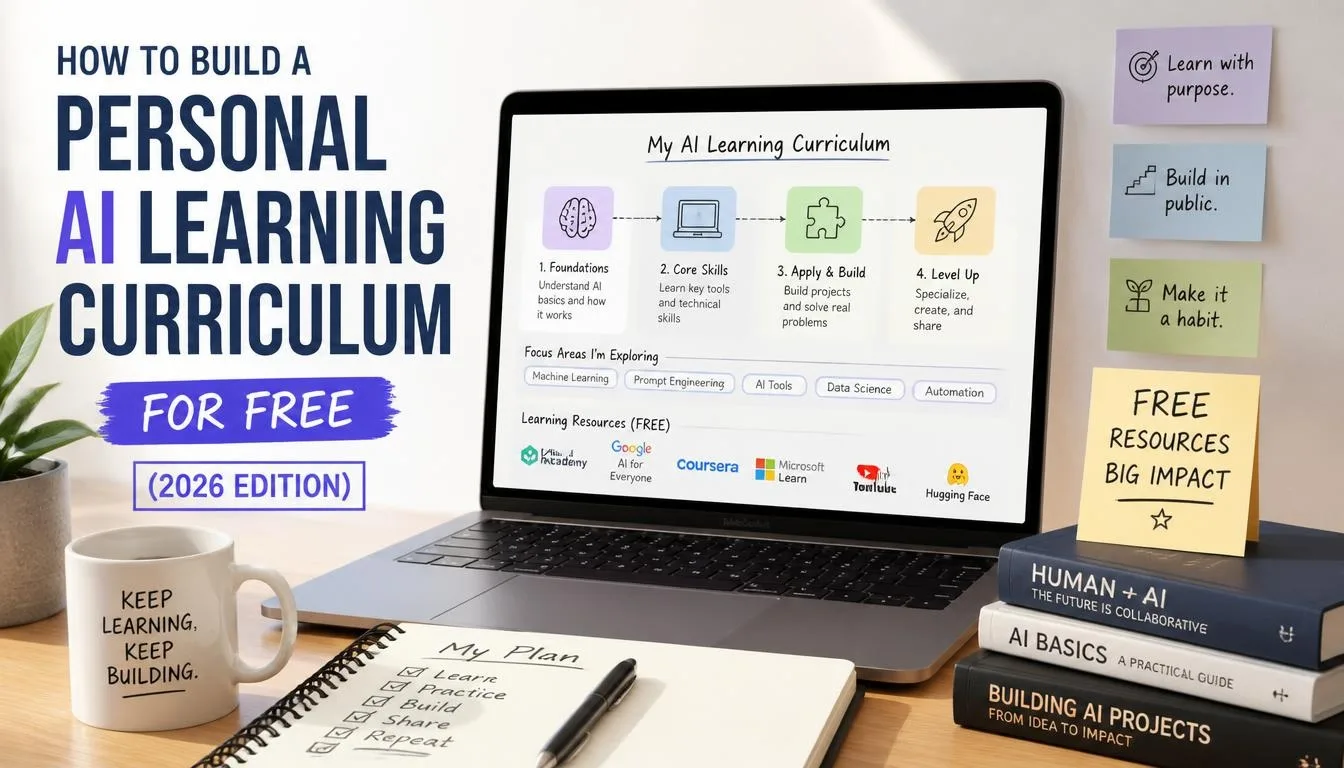
Most people learning artificial intelligence today are falling into a massive trap: they are treating YouTube playlists and generic MOOCs like a modern college degree. They watch tutorials on transformer architectures, build a basic chatbot from a GitHub repository, and wonder why they still cannot architect a production-ready RAG pipeline or fine-tune an open-weights model on specialized domain data.
The reality of the current AI landscape is stark. Standardized courses are obsolete the moment they finish rendering because the underlying infrastructure—from inference engines to agentic frameworks—shifts every six months. If you want to master AI without spending a dime on bootcamps or university extensions, you cannot rely on a static syllabus. You must act as your own Chief Learning Officer and construct a dynamic, highly targeted, zero-cost curriculum.
Over the past several years of building ML systems and mentoring engineers, I have refined a framework for building a personal AI learning curriculum that leverages open-source tooling, frontier models, and community-driven knowledge bases. Here is the blueprint.
The Core Philosophy: Project-First, Theory-SecondTraditional education teaches theory first, application later. In AI, this approach guarantees failure. By the time you understand the calculus behind backpropagation, the frameworks you need to apply it have already deprecated the API.
Your curriculum must be anchored in a reverse-engineering methodology. You start by identifying a production problem—such as processing unformatted PDF financial disclosures into a structured vector database—and you trace backward through the mathematical and software engineering layers only as deeply as necessary to solve the bottleneck.
- Theory without code is just expensive trivia.
- Code without theory is fragile script-kiddie engineering.
- Project-driven learning forces deep conceptual acquisition because failure has immediate, tangible consequences.
Before you pull a single repository, you must map your current capabilities. Be brutally honest about your baseline.
- Level 0 (The Integrator): Comfortable with Python basics, API calls, and prompt engineering. Goal: Learn to wire models into deterministic software.
- Level 1 (The Builder): Proficient in software engineering, basic data science libraries (Pandas, NumPy), and local model deployment. Goal: Learn retrieval systems, fine-tuning, and evaluation metrics.
- Level 2 (The Researcher/Architect): Deep math, C++/CUDA understanding, optimization, and architecture design. Goal: Custom model training and distributed systems.
For the remainder of this guide, we will focus on bridging Level 0 to Level 1, as this is where 95% of career leverage currently resides.
Phase 1: Zero-Cost Resource AllocationYou do not need a $15,000 bootcamp to access world-class AI education. In fact, some of the best material is locked inside open-source repositories and research labs that publish their pedagogical notes publicly. Here is your free resource stack:
- The Mathematical Grounding: 3Blue1Brown’s Neural Networks series on YouTube for visual intuition; Khan Academy for linear algebra and calculus refreshers.
- The Engineering Foundations: Andrej Karpathy’s 'Neural Networks: Zero to Hero' series. This is arguably the single most valuable free educational asset on the internet. It takes you from basic Python to building micrograd, makemore, and a GPT from scratch.
- The Systems Architecture: The Chip Huyen blog and her book companion repositories, focusing on MLOps and LLM system design.
- The Frontier Literature: arXiv Sanity or direct RSS feeds of top papers. Do not read the math heavy sections initially; read the Introduction and Conclusion, then reverse-engineer the architecture through implementation.
Divide your self-directed timeline into four distinct quarters, treating each as an intensive sprint. You should aim for 10 to 15 hours of focused, deliberate practice per week.
Quarter 1: The Foundations of Applied Python and InferenceStop relying entirely on cloud APIs like OpenAI or Anthropic for your learning. Your first quarter must focus on running models locally and understanding the inference layer.
- Milestone Project: Run an open-weights model (like Llama 3 or Mistral) locally using Ollama or llama.cpp. Build a Python CLI utility that interacts with it without using commercial API keys.
- Key Concepts to Master: Tokenization, context windows, temperature/top-p sampling, and basic JSON output parsing from local LLMs.
- Free Tooling Stack: Python 3.11, VS Code, Ollama, Hugging Face Hub (datasets and transformers libraries).
Context windows are expanding, but RAG remains the enterprise standard for grounding models in proprietary data. Most tutorials teach you how to write five lines of LangChain code; real engineers know how the underlying plumbing works.
- Milestone Project: Build a custom RAG engine from scratch using raw Python and a lightweight vector store (like ChromaDB or FAISS), completely bypassing heavy abstraction frameworks initially so you understand chunking strategies, embedding spaces, and cosine similarity.
- Key Concepts to Master: Semantic search, chunking strategies (fixed-size vs. semantic), embedding models, evaluation metrics (RAG triad: context relevance, groundedness, answer relevance).
- Free Tooling Stack: ChromaDB, Sentence-Transformers, LlamaIndex (only after building a naive version from scratch).
The paradigm is shifting from static chat interfaces to autonomous agents that can plan, execute, evaluate, and iterate. This requires understanding how to give models agency through function calling and state management.
- Milestone Project: Build a multi-agent research assistant that takes a broad topic, delegates sub-tasks to specialized prompts (e.g., researcher, writer, critic), and compiles a verified markdown report.
- Key Concepts to Master: Function calling, JSON schema validation, state graphs (LangGraph), self-correction loops, and error handling in non-deterministic systems.
- Free Tooling Stack: LangGraph, Instructor (for structured outputs), open-source tool-use models.
When prompting and RAG fail to capture a specific domain tone, formatting structure, or reasoning pattern, you must fine-tune. Thanks to parameter-efficient fine-tuning (PEFT), you can now do this on consumer hardware or free cloud tiers.
- Milestone Project: Fine-tune a 7B or 8B parameter model using QLoRA (Quantized Low-Rank Adaptation) on Google Colab’s free T4 GPU tier to generate synthetic data in a highly specific proprietary format.
- Key Concepts to Master: LoRA/QLoRA mechanics, dataset curation and formatting (Alpaca/ShareGPT styles), quantization (4-bit/8-bit), and loss curves.
- Free Tooling Stack: Unsloth (open-source library for fast PEFT), Google Colab (Free Tier), Hugging Face TRL (Transformer Reinforcement Learning).
A self-taught curriculum is worthless in the job market or entrepreneurial ecosystem unless it is verifiable. Traditional credentials rely on certificates; AI engineering relies on a public portfolio of deployed utility.
As you move through your quarterly milestones, enforce these rules:
- Push everything to GitHub: Write clean READMEs that explain not just how to run the code, but the architectural trade-offs you encountered and how you solved them.
- Build in Public: Share your failures on platforms like X, LinkedIn, or personal technical blogs. Documenting why a RAG pipeline hallucinated or how you fixed an out-of-memory error on a Colab GPU proves high-level competence.
- Contribute Upstream: Find a minor bug or documentation gap in an open-source library you use (like a LangChain integration or a Hugging Face helper script) and submit a pull request.
Before committing to this path, evaluate whether a free, self-built curriculum aligns with your learning style and career goals.
- Pros:
- Total control over pacing and focus areas.
- Zero financial barrier to entry.
- Forces you to learn modern, production-grade tools rather than outdated academic theories.
- Builds genuine problem-solving grit that bootcamps often sanitize.
- Cons:
- Requires immense self-discipline and metacognition.
- No structured community or built-in networking unless you intentionally seek one out.
- Debugging environment setup issues can cause significant friction for absolute beginners.
Do not spend weeks agonizing over your syllabus design. Analysis paralysis is the silent killer of self-directed education. Execute this exact sequence over the next week to launch your curriculum:
- Day 1: Install Python, set up a virtual environment, and install Ollama. Download Llama 3 (8B) and run your first local inference prompt via terminal.
- Day 2-3: Complete Andrej Karpathy’s 'Let's build GPT: from scratch, in code, spelled out' video. Type out every line of code yourself; do not copy-paste.
- Day 4-5: Spin up a free Google Colab notebook and experiment with a Hugging Face pipeline for text generation or embeddings.
- Day 6-7: Define your Quarter 1 Capstone Project. Write out the project requirements in a markdown file, push it to a new GitHub repository, and begin building.
The barrier to entering artificial intelligence has never been lower, but the noise floor has never been higher. By rejecting generic courses and engineering your own project-first curriculum, you bypass the tutorial hell that traps most learners and build actual, undeniable capability.
How to Build a Personal AI Learning Curriculum for Free (2026 Edition)
Learn AI for free in 2026 with a project-first personal curriculum. Master local models, RAG, and AI agents without expensive bootcamps.