
Architecting an AI-Powered Personal Knowledge Management System That Actually Thinks With You

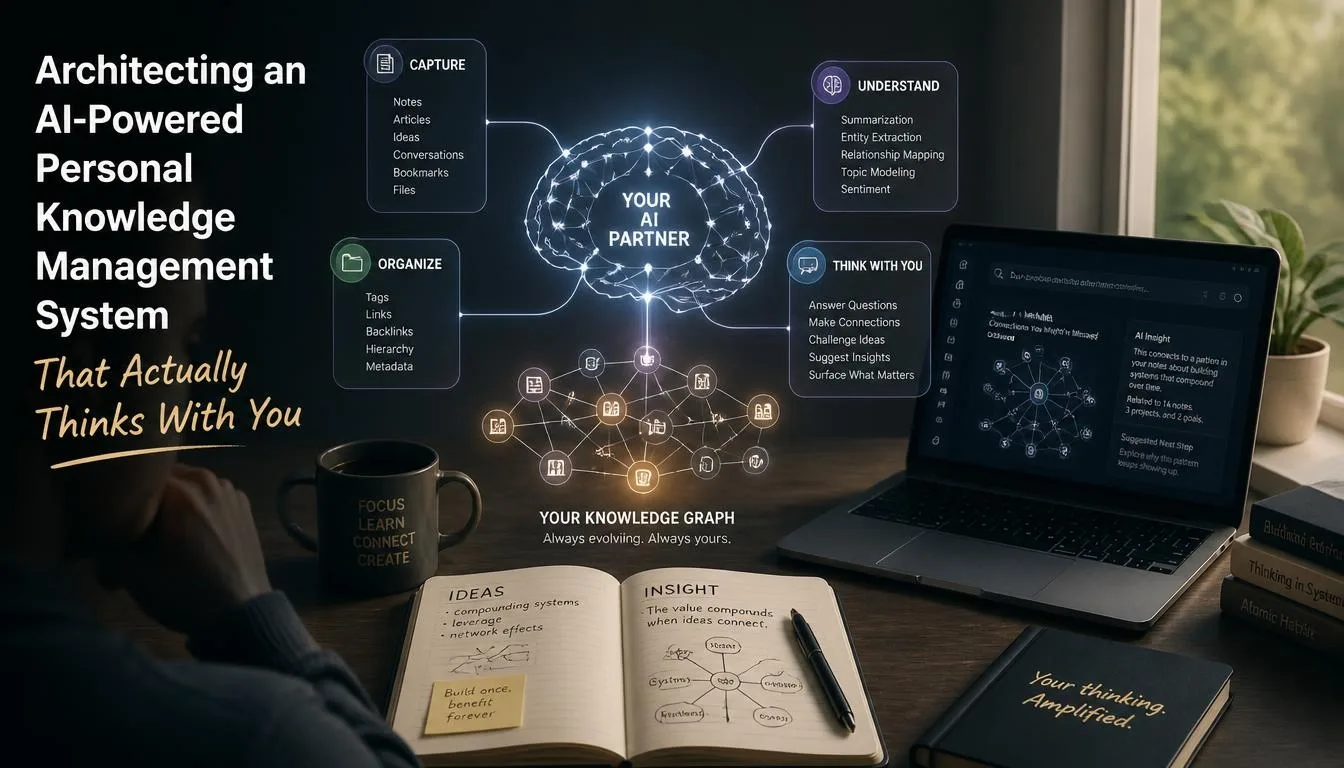
Most Personal Knowledge Management (PKM) systems fail because they are designed as digital cemeteries. We spend hundreds of hours capturing highlights, tagging PDFs, and organizing markdown files in Notion, Obsidian, or Logseq, only to watch that information rot in a silo. Traditional PKMs rely on retrieval architectures that force you to remember where you stored an idea before you can use it. That is a massive friction point.
By integrating Large Language Models (LLMs) and vector embeddings directly into your workflow, you shift the paradigm from manual archiving to synthetic retrieval. You stop being a digital librarian and start acting as the editor-in-chief of your own externalized cognitive network. Here is the exact architecture I use to run an AI-augmented PKM that continuously compounds my intellectual output.
The Architecture of an AI-Augmented PKMAn effective AI-native PKM is not a single app; it is a three-tier data pipeline consisting of ingestion, vectorization, and generative synthesis. If any of these tiers break, your system degrades into a glorified search engine.
Tier 1: High-Velocity IngestionCapture must be frictionless. If it takes more than three clicks to save a thought, an article, or a transcript, you won't do it. However, raw capture is useless without context. When I clip a research paper or a podcast transcript, my capture tool automatically appends metadata: timestamp, source domain, author authority score, and an automated one-sentence summary generated by a lightweight LLM (such as GPT-4o-mini).
Avoid manual tagging. Manual tagging is a relic of pre-semantic web architecture. Categories are rigid; human thought is fluid. Instead of deciding whether an article on 'attention economics' belongs in 'Marketing' or 'Psychology,' let the system ingest the raw text and let semantic embeddings handle the classification later.
Tier 2: Vectorization and Semantic IndexingThis is where the magic happens. Traditional PKMs use keyword search—if you search for 'retention,' you miss notes that discuss 'keeping customers' or 'user churn.' AI-driven PKMs (using tools like Obsidian with the Smart Connections plugin, or specialized apps like Khoj and MyMind) convert your notes into high-dimensional vector embeddings.
- Semantic Proximity: Ideas that mean the same thing sit close to each other in vector space, regardless of the vocabulary used.
- Automated Backlinking: The AI scans your new note against your entire historical database and suggests conceptual links you never realized existed.
- Local Privacy vs. Cloud Convenience: For proprietary or sensitive data, running local embedding models via Ollama ensures your intellectual property never leaves your machine.
Never read your notes directly when you can converse with them. Instead of opening a folder to review past research on market entry strategies, I prompt my vector database: 'Based on my last three years of startup notes, what are the primary failure modes I've identified for B2B SaaS pricing?'
The system pulls the exact source notes, synthesizes the core themes, and presents a synthesized briefing complete with citations. This transforms your PKM from a static storage unit into an active sparring partner.
Step-by-Step Implementation: Building Your AI Second BrainTheory is cheap; execution compounds. Here is how to construct this stack from scratch this weekend.
Step 1: Choose Your Core Markdown RepositoryDo not lock your knowledge into a proprietary cloud app that can hold your data hostage. Use a local-first markdown editor like Obsidian or Logseq. Markdown ensures your notes remain readable plain text for decades, long after current AI companies pivot or shut down.
Step 2: Deploy Local and Cloud AI BridgesIntegrate intelligence directly into your editor. Configure plugins that connect your local vault to both local models (via LM Studio or Ollama for privacy) and frontier models (via API keys for heavy lifting). Your setup should allow you to:
- Select any paragraph in your vault and hit a shortcut to rewrite it in your personal voice.
- Generate atomic flashcards from dense technical documentation automatically.
- Run semantic search queries across 10,000+ notes in under a second.
An AI PKM requires maintenance, but the AI should do the heavy lifting. Once a week, run a script or a specialized prompt over your inbox and capture folders: 'Analyze my notes from the last 7 days. Identify 3 recurring themes, 1 contradiction in my thinking, and suggest an outline for an essay combining these ideas.'
This single workflow turns passive reading into active publishing. It closes the loop between consumption and creation.
The Pitfalls of AI Knowledge Management (And How to Avoid Them)Building an AI-driven PKM comes with distinct failure modes that can quietly sabotage your productivity.
1. The Hallucination TrapLLMs love to invent connections that sound brilliant but are factually baseless. The Fix: Always configure your AI retrieval tools with strict citation boundaries. If the model cannot point to the exact markdown file and line number supporting a claim, discard the output.
2. Over-Automation and Cognitive AtrophyIf you let the AI summarize everything, you stop engaging in deep, uncomfortable reading. If you don't struggle with an idea during ingestion, it will never encode into your biological memory. The Fix: Use AI to retrieve and synthesize, but write your own atomic summaries in your own words. Friction is essential for genuine learning.
3. Prompt Engineering FatigueConstantly writing complex prompts to extract insights gets exhausting. The Fix: Build reusable prompt templates or leverage agentic workflows that trigger automatically when you drop a note into specific folders.
Case Study: How a Technical Founder Uses This SystemConsider a real-world application: A technical founder managing codebases, investor updates, hiring notes, and product roadmaps.
Instead of searching five different platforms, everything flows into a single Obsidian vault backed by a local vector database. When preparing for an investor pitch, the founder prompts the system: 'Pull all customer objections noted in sales calls over the last quarter, cross-reference them with our engineering roadmap, and draft a response strategy.'
The AI retrieves raw meeting transcripts, highlights recurring pain points, and matches them against GitHub commit summaries. What used to take four hours of manual searching now takes 90 seconds. That is the leverage an AI PKM provides.
The Future of Personal IntelligenceWe are moving past the era of folders and tags. The future belongs to decentralized, semantic knowledge graphs powered by private, localized AI models that understand our unique cognitive fingerprints. By building your AI-powered PKM today, you aren't just organizing files—you are engineering an external cognitive architecture that scales linearly with your curiosity.
Architecting an AI-Powered Personal Knowledge Management System That Actually Thinks With You
Learn how to build an AI-powered personal knowledge management system using vector embeddings and LLMs to turn notes into active insights.