
How to Disclose AI Use in Freelance Work Without Losing Clients (The Expert Blueprint)

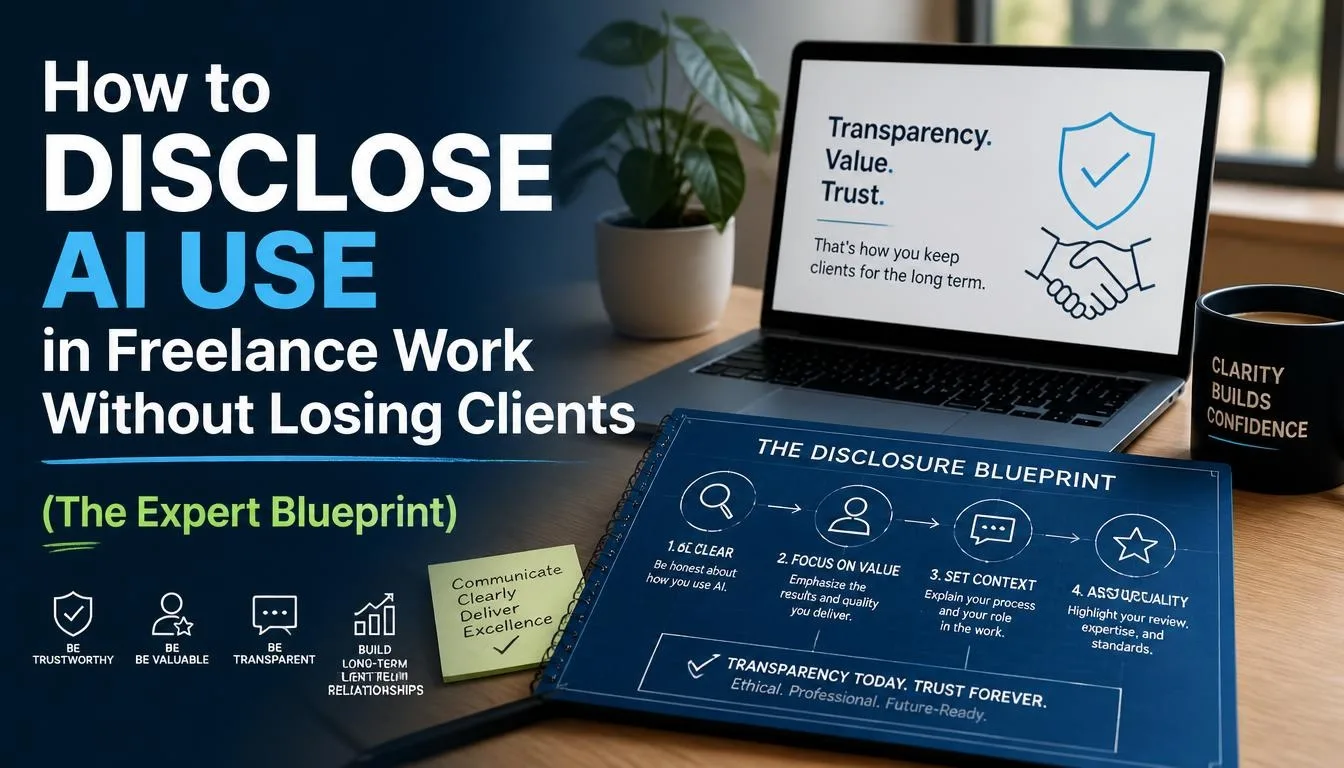
Most freelancers approach AI disclosure like a confession. They write sheepish emails apologizing for using an LLM to outline a whitepaper, or they hide their workflow in the shadows, terrified that transparency will trigger a contract cancellation. Both approaches are fundamentally flawed. Clients do not care if you use artificial intelligence; they care about value, liability, IP ownership, and hidden costs.
After navigating enterprise-level contracts and managing high-volume freelance operations across copywriting, software engineering, and design, I have learned one immutable truth: clients do not punish efficiency. They punish deception and compromised quality. When you frame AI as a force multiplier rather than a replacement for human intellect, disclosure stops being a vulnerability and becomes a competitive advantage.
The Psychology of Client Fear Around AIBefore designing a disclosure framework, you must understand why clients react negatively to AI in the first place. Their anxiety usually stems from three legitimate business risks:
- Intellectual Property and Copyright Risk: Can the client legally own work generated or assisted by an AI model? Under current US Copyright Office guidelines, purely machine-generated works lack human authorship and cannot be copyrighted. If you hand over unedited AI output, you are potentially handing over unprotectable IP.
- Data Privacy and Confidentiality: Did you feed their proprietary strategy documents into a public LLM, effectively training a competitor's model on their trade secrets?
- The "Pay Less" Fallacy: If a machine wrote the blog post in two seconds, why are they paying you an hourly rate or a project fee? They fear they are paying human rates for robotic margins.
Your disclosure strategy must proactively neutralize these three fears before they even form in the client's mind.
The 3 Tiers of AI Integration in FreelancingNot all AI use is created equal. Lumping code generation, research summarization, and final output creation into the same bucket is a recipe for disaster. To disclose effectively, you must categorize your workflows into three distinct tiers.
Tier 1: Foundational & Ideation AI (Zero Disclosure Needed)This includes using AI as a digital brainstorming partner, a dictionary, a grammar checker (like Grammarly), or a transcription cleaner (like Whisper). You do not need to tell a client that you used an LLM to generate 50 headline ideas to filter through, nor do you need to disclose that an AI helped you organize a messy transcript into bullet points.
The Rule: If the AI touches the scaffolding but never forms the foundation or the finish, it is a tool—no different than using a spellchecker in Microsoft Word or a vector search engine for research.
Tier 2: Accelerated Production & Drafting (Selective Disclosure)This is where things get nuanced. You use AI to draft the first version of a routine blog post, write standard boilerplate unit tests for code, or generate mood boards for a design project. The output is heavily edited, fact-checked, and injected with human voice and domain expertise.
The Rule: Disclose when the client contract specifies human-only production, or when the deliverable relies heavily on original thought leadership. Otherwise, frame it in your onboarding materials as part of your modern, optimized workflow stack.
Tier 3: Full-Scale Generation (Mandatory Disclosure & Risk Mitigation)You are using AI to generate the core code, imagery, or text with minimal human intervention. If you are operating here without explicit client consent, you are violating professional ethics and risking your business.
The Rule: Always disclose upfront. Pair the disclosure with an ironclad guarantee regarding IP assignment and compliance.
How to Write an AI Disclosure That Builds TrustStop apologizing for your tools. Instead of writing, "Just so you know, I used ChatGPT to help write this," which sounds amateurish and uncertain, use professional framing that highlights your editorial oversight.
The "Human-in-the-Loop" FrameworkClients want to know that a professional brain is steering the ship. Your disclosure should emphasize curation, validation, and safety. Here is a real-world script you can adapt for your proposals or onboarding documents:
Workflow Transparency Note:
To maximize efficiency and maintain aggressive turnaround times, I utilize advanced AI tools for initial research synthesis, structural outlining, and rough drafting. However, every deliverable undergoes rigorous human editing, brand-alignment checks, and rigorous fact-checking by me. You are paying for my strategic oversight, editorial standards, and final quality control. All deliverables comply with strict data privacy protocols and are structured to ensure clean IP transfer.
Why this works:
- It reframes AI from a "cheat code" to an "efficiency driver."
- It explicitly addresses quality control (human editing).
- It preemptively solves their legal worries (IP transfer and data privacy).
Different clients require wildly different disclosure approaches based on their risk tolerance and internal compliance policies.
Enterprise and Regulated Industries (Fintech, Legal, Healthcare)In these sectors, assume zero-tolerance for unvetted AI use. Legal departments view public LLMs as data leaks waiting to happen. For these clients:
- Only use enterprise-tier AI tools with zero-data-retention guarantees (e.g., enterprise APIs or local open-source models like Llama 3 hosted securely).
- Include an AI clause in your Statement of Work (SOW) explicitly stating what tools are used and how data is secured.
- When in doubt, ask: "Does your internal policy permit AI-assisted drafting for marketing assets? I want to ensure my workflow aligns with your compliance standards." This positions you as a sophisticated, safety-conscious partner.
These clients usually care about two things: speed and cost-effectiveness. They are often experimenting with AI themselves. For them, your AI proficiency is a selling point.
- Market your use of AI as an asset: "By leveraging modern AI-assisted workflows, I can deliver a comprehensive content calendar in half the time without sacrificing quality."
- Pass the efficiency savings down strategically or pocket the higher hourly yield while keeping project fees competitive.
Eventually, you will encounter a client who reacts poorly to an AI disclosure. Perhaps they had a bad experience with a lazy freelancer who pasted unedited LLM garbage. How you handle this objection dictates whether you keep the contract.
Step 1: Validate, don't defend. Never argue with a client's fear. Say: "I completely understand. There is a lot of low-quality, automated content flooding the market right now, and protecting your brand voice is paramount."
Step 2: Pivot to your human value. Reiterate your editorial filter: "That is why my process relies on AI strictly as an efficiency tool for outlines and raw data organization. Every single word of the final copy is written, structured, and fact-checked by me to match your exact brand guidelines."
Step 3: Offer a test. "Let's do a trial piece. If the quality doesn't match your exact standards, I will manually rewrite it from scratch." (Spoiler: Because you are a skilled professional who edits the output heavily, it will pass with flying colors).
Final Checklist for Ethical, Profitable AI Disclosure- Read the contract: Check for specific clauses regarding automated tools, sub-contractors, or AI usage.
- Protect data privacy: Never input client PII, trade secrets, or unreleased financials into public LLMs.
- Own the output: If the AI makes a factual error, it is your fault. Never blame the algorithm.
- Be transparent by default: Bake your AI workflow into your onboarding deck so it never feels like a secret you are keeping.
Transparency isn't about giving away your trade secrets—it's about building an unshakeable foundation of trust with clients who value results above all else.
How to Disclose AI Use in Freelance Work Without Losing Clients (The Expert Blueprint)
Learn how to disclose AI use in freelance work without losing clients. Master professional frameworks, exact scripts, and ethical AI workflows.