
How Small Businesses in Developing Countries Can Outcompete Global Giants Using AI

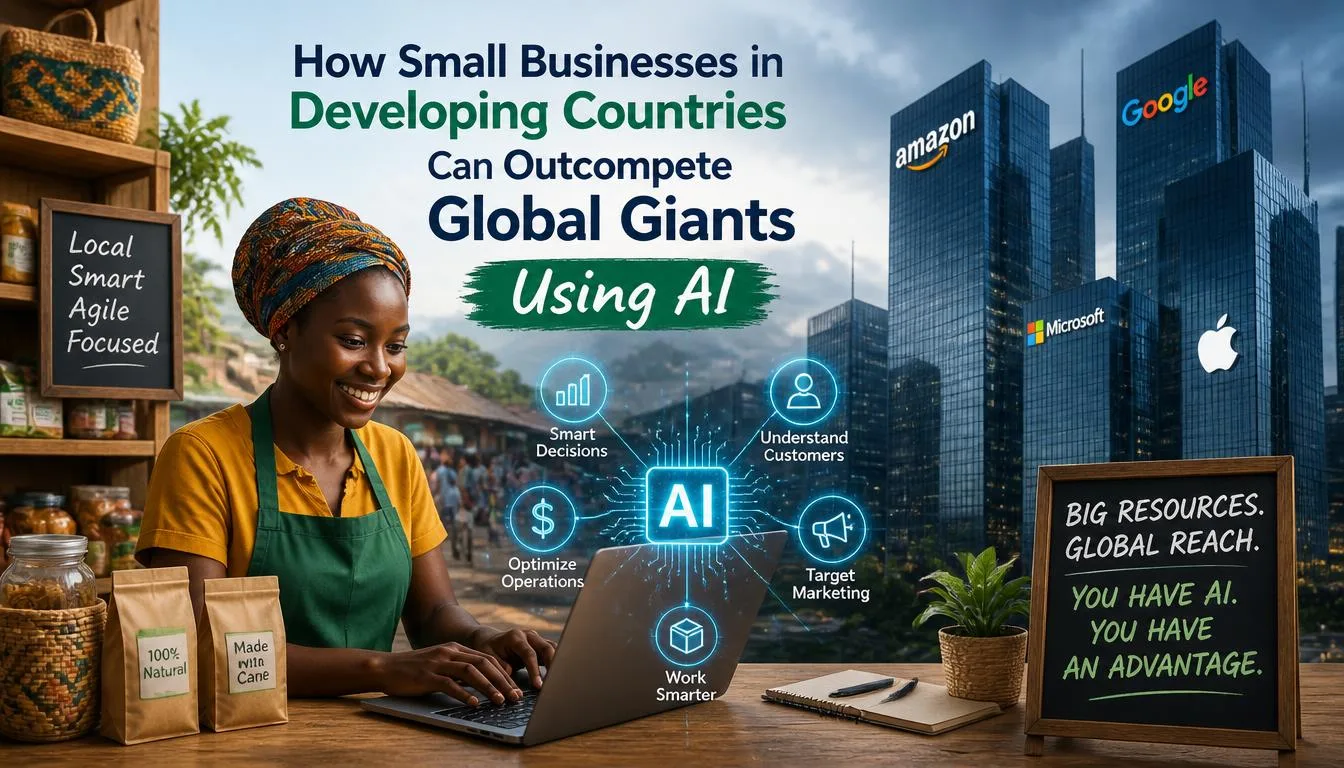
Geographic barriers to international trade have effectively dissolved, yet a structural disadvantage has historically plagued small and medium-sized enterprises (SMEs) in developing economies. Enterprises in Nairobi, Bogotá, or Dhaka routinely lost global pitches not due to inferior products, but because of insurmountable operational deficits—specifically, a lack of round-the-clock multilingual customer support, lean localized marketing teams, and the capital required to analyze massive streams of export data.
Artificial intelligence fundamentally rewrites this economic equation. Over the past four years advising export-oriented businesses across Southeast Asia and Sub-Saharan Africa, I have witnessed a structural shift: generative and predictive AI tools allow a five-person enterprise in Vietnam to project the operational footprint and market authority of a fifty-person firm in London or New York. This is not about incremental efficiency gains; it is about asymmetric warfare in global commerce.
The Economic Realities of Developing Markets in Global TradeTo understand why AI is a generational equalizer, we must first confront the traditional bottlenecks limiting developing-nation SMEs:
- The Trust Deficit: International buyers associate emerging-market suppliers with communication latency, irregular quality control, and opaque supply chains.
- Resource Constraints: Hiring native-speaking copywriters, international legal counsel, and data analysts is financially prohibitive for local balance sheets.
- Information Asymmetry: Access to real-time market intelligence, regulatory shifts in target export zones, and pricing fluctuations in Western markets has historically required expensive enterprise subscriptions.
AI neutralizes these friction points at marginal cost. By deploying targeted artificial intelligence workflows, an agro-processor in Kenya or a textile manufacturer in Pakistan can bridge the capability gap that previously relegated them to local markets.
Pillar 1: Eliminating the Language and Culture BarrierGlobal commerce runs on localized nuance. Translating a product description into Spanish or French using legacy tools often yields rigid, unnatural copy that signals an outsider status to prospective buyers. Modern Large Language Models (LLMs) operate differently; they process cultural idioms, regional buyer psychology, and industry-specific jargon with uncanny precision.
Deploying Context-Aware Translation and LocalizationWhen an artisanal furniture exporter in Indonesia wants to pitch boutique interior designers in Scandinavia, literal translation fails. Instead, deploying a fine-tuned LLM allows the business to:
- Rewrite product pitches to match the minimalist, sustainability-focused tone valued in Nordic markets.
- Generate culturally resonant email outreach campaigns that mirror native copywriters.
- Analyze incoming buyer inquiries for underlying cultural expectations, advising the sales team on how to structure negotiations.
Time zones are a silent killer of international deals. A buyer in Los Angeles sending an inquiry at midnight local time expects a response before their morning coffee. For a developing-nation SME, maintaining a 24/7 global support team is economically unviable.
By implementing retrieval-augmented generation (RAG) chatbots trained on the company’s exact inventory, shipping terms, and past communications, SMEs can provide human-grade responses around the clock. These systems do not just answer FAQs; they issue dynamic shipping quotes, check inventory levels via API integrations, and escalate high-value leads to human founders instantly.
Pillar 2: Bridging the Enterprise Marketing and Branding GapWestern brands dominate global e-commerce because they outspend competitors on high-production content, sophisticated SEO architectures, and targeted programmatic advertising. For a bootstrapped business in a developing country, competing on ad spend is a losing strategy. The strategy must instead be hyper-efficient content dominance.
Generative Visuals and Synthetic Product MediaProduct photography is a notorious expense for export businesses. Shipping samples to a studio in New York or hiring local commercial photographers eats into operating capital.
Generative AI imaging tools allow businesses to place their physical products into hyper-realistic, culturally tailored digital environments. A handcrafted leather bag manufactured in León, Mexico, can be rendered within an upscale Parisian cafe, a Tokyo street style shoot, or a New York loft—all generated from a single smartphone photo of the product against a neutral background. This elevates the visual equity of the brand instantly to Western standards.
Programmatic SEO and Global Content EnginesOrganic search remains the highest-ROI acquisition channel for international B2B and B2C sales. Using AI agents, developing-nation SMEs can build comprehensive content architectures that target long-tail search queries across dozens of countries simultaneously.
Case-in-point workflow: An agricultural cooperative in Peru exporting organic superfoods uses programmatic AI workflows to generate localized landing pages in German, Japanese, and English. Each page targets hyper-specific import keywords (e.g., "bulk organic maca powder supplier B2B Rotterdam"), complete with localized regulatory compliance disclaimers and localized currency conversions.
Pillar 3: Predictive Operations and Supply Chain ResilienceExporting introduces severe logistical complexities: port congestion, volatile freight rates, sudden tariff adjustments, and currency fluctuations. Large multinational corporations use predictive analytics suites costing hundreds of thousands of dollars to navigate these waters. Developing-nation SMEs can now replicate these capabilities using accessible cloud-based AI tools.
Demand Forecasting and Inventory OptimizationOverproducing ties up vital working capital; underproducing leads to lost export contracts. AI-driven forecasting models ingest historical sales data, local weather patterns, macroeconomic indicators, and global shipping indices to predict demand spikes with unprecedented accuracy.
Automated Compliance and Regulatory NavigationNavigating export documentation—such as EU carbon border adjustment mechanisms (CBAM), FDA clearances, or complex certificates of origin—traditionally requires expensive customs brokers.
AI compliance agents can scan evolving international trade regulations daily, cross-reference them with a company's product specifications, and automatically flag missing documentation or potential regulatory violations before goods leave the warehouse. This eliminates costly port delays and cargo rejections.
The Implementation Playbook: How to Start Without CapitalThe greatest misconception among emerging-market entrepreneurs is that adopting AI requires massive IT investments or specialized data science teams. In reality, the modern AI stack is accessible, modular, and largely low-code.
- Audit the Bottlenecks: Do not adopt AI for the sake of it. Identify the exact friction point preventing global growth—is it slow email response times, poor product imagery, or lack of market research?
- Build a Lean Tool Stack: Combine foundational LLMs (like Claude or GPT-4o) with specialized wrappers for translation, image generation (Midjourney or Stable Diffusion), and customer service (Custom GPTs or Voiceflow).
- Train the Human-in-the-Loop: AI is a multiplier of human intent, not a replacement for domain expertise. Ensure that your core team understands how to prompt, verify, and edit AI outputs to maintain authentic brand voice and factual accuracy.
- Iterate and Scale: Start with a single international channel—such as optimizing your B2B LinkedIn outreach or upgrading your e-commerce product catalog—before deploying autonomous workflows across the entire business.
Globalization was once an asymmetrical playground where capital intensity determined success. Artificial intelligence fundamentally disrupts this dynamic. By weaponizing AI for localization, marketing execution, and operational foresight, a small business in a developing economy can project global authority, out-maneuver legacy incumbents, and capture international market share on its own terms.
How Small Businesses in Developing Countries Can Outcompete Global Giants Using AI
Discover how SMEs in developing countries use AI to overcome language barriers, scale marketing, and outcompete global giants. Expert guide.